In recognition of the world’s rapidly worsening biodiversity crisis, Commonwealth and State Governments have committed to the Global Biodiversity Framework target to protect 30% of Australia by 2030. In accordance with the National Roadmap for achieving 30by30 the governments have released maps showing priority areas for protection, identifying State Forests in north-east NSW as amongst the highest priorities in Australia for areas with important biodiversity and ecosystem values and relatively low levels of protection. This includes as high priorities all State Forests in the Northern Rivers, including the Richmond River Koala Parks.
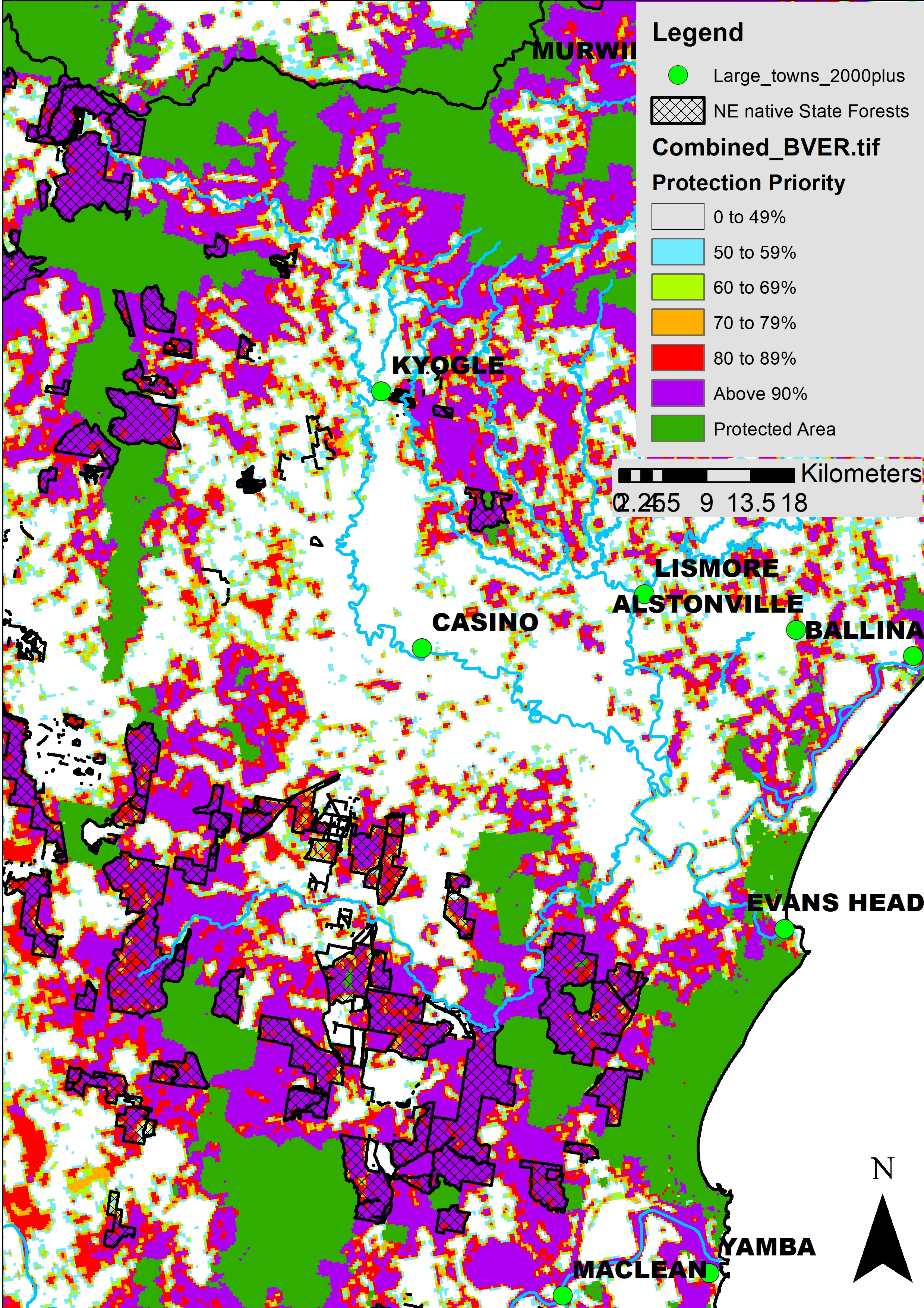
Richmond River: Commonwealth mapped priorities for additions to the national reserve system to achieve 30by30, based on areas known to have important biodiversity and ecosystem values that are not well represented in Australia’s existing protected areas (Combined_BVER), purple is the highest national priority. State Forests are overlaid black hatching.
Northern Rivers Reserves
The catchments of the Northern Rivers (Clarence, Richmond, Tweed, Brunswick, and small coastal catchments south to Wooli Wooli River) encompass 3.1 million hectares. Within these catchments there 625,000 ha of National Parks (20%), and 509,000 ha of native State Forests (16%) that need to be protected and rehabilitated.
Koalas are widespread throughout the Northern Rivers, with the Clarence River representing a dispersal barrier creating genetically different populations. Hollow-dependent species, such as cockatoos, gliders and owls, are also wide spread but diminished in forests denuded of old trees.
These State Forests provide important habitat in their own right and essential habitat linkages to facilitate dispersal between isolated reserves.
Within the Richmond River and Western Border Ranges, plantations were historically established by clearing native forests, including by clearing within rainforests on the basalt plateaux. At the end of plantation rotations there is a need to restore the rainforests and essential corridors in key linkages to improve connectivity.
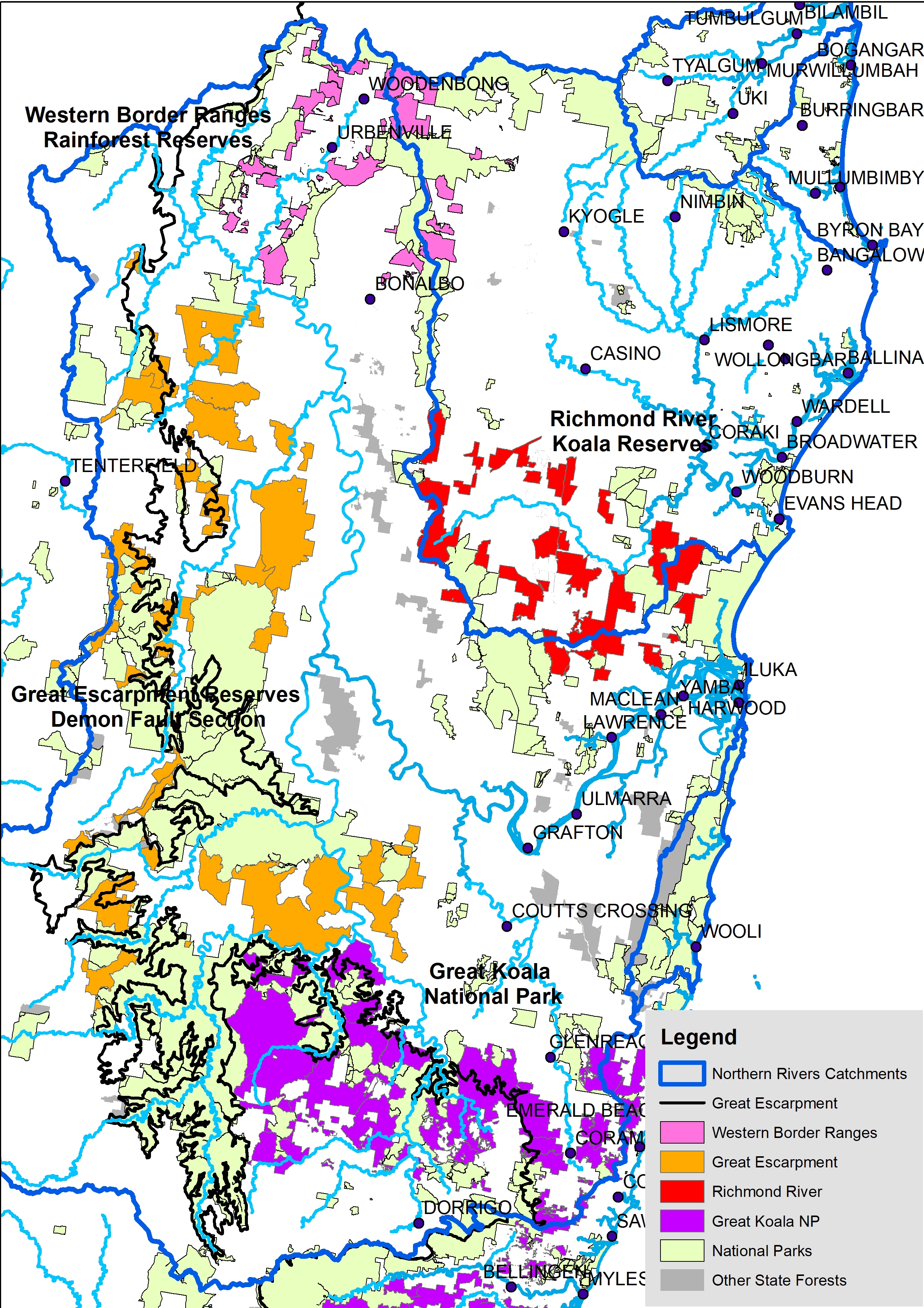
While we want all native State Forests protected, there are four major groups to focus on:
Great Koala National Park; extends further south, and the NSW Government is currently in the process of deciding how big it will be.
Richmond River Koala Reserves; 56,000 ha of State Forests in the southern Richmond River valley and along the southern Richmond Range. The forests are primarily dry forests dominated by Spotted Gum and Grey Box, with extensive Red Gum woodlands and welands on the Richmond floodplain. These occur on 250-65 million year old sediments of the Clarence-Moreton Basin, deposited in sequences of swamps, rivers and lakes as the basin subsided and filled during the dinosaur era.
These forests encompass the largest area of identified Koala habitat in the Richmond catchment. They provide critical winter nectar resources for a multitude of migratory, nomadic and resident nectivores, and vital refuges for a suite of threatened woodland birds, including Barking Owl. They provide potential habitat for over 130 threatened species, along with an Endangered Population of coastal emus. They support a suite of plants endemic to the Clarence-Moreton Basin or with disjunct populations in the Sydney basin. They are vital for restoring the health of the Richmond River.
Western Border Ranges Rainforest Reserves; 46,460 ha of native State Forests in the western Border Ranges (McPherson, Richmond, Tooloom, Koreelah and Great Dividing), in the headwaters of the Clarence and Richmond Rivers. The forests are primaily wet forests, with major stands of rainforest on basalt plateaux. These plateaux are remnants from the Focal Peak volcano (centered to the north of Woodenbong) that erupted through the Clarence-Moreton Basin 21-25 million years ago.
As well as Koalas and a range of hollow-dependent fauna, these forests are particularly important for the suite of wet forest species endemic to the Border Ranges, these include Albert’s Lyrebird, Marbled Frogmouth, Fleay’s Barred Frog, Mountain Frog, Richmond Range Frog, and Red and Yellow Mountain Frog. These forests used to also be strongholds for Coxens Fig Parrot and Black-breasted Button-quail, though these haven’t been seen in recent years. They are outstanding importance for their diversity of macropods.
Great Escarpment Reserves – Demon Section; 178,253 ha of native State Forests along the 3,600 km Great Escarpment that stretches from from near the tip of Cape York Peninsula to south eastern Victoria. This section formed along the Demon Fault that displaced land on each side by 19-35 km around 230 million years ago, creating significant geological and vegetation differences on opposite sides, and facilitating erosion. The Great Escarpment is Australia’s most important corridor for the dispersal of forest fauna, including in response to climate change.
This section includes three large wilderness areas and extensive old growth forests, along with Australia’s largest stand of Warm Temperate rainforest. It is particularly important for hollow-dependent species, with dense populations of Greater Gliders. Pugh’s Frog is a local endemic. Other threatened species of particular importance are Brush-tailed Rock Wallaby, Parma Wallaby, Hastings River Mouse, and Rufous Scrub Bird.
The Richmond River Koala Parks Campaign Team acknowledges the traditional custodians of the lands within the proposed Richmond River Koala Parks . We pay our respect to the past, present and emerging Elders of the Bandjalang and West Bundjalung Nations.
We will continue to work closely with Aboriginal communities, groups and knowledge holders during our campaign to see the Richmond River Koala Parks become a reality.
Do you like this page?